SKYLIGHT 1 established a measurable benefit of fezolinetant for moderate-to-severe vasomotor symptoms—the hot flashes and night sweats associated with menopause. Among 527 randomized women, the 45 mg study arm had about two fewer daily symptoms beyond the placebo improvement at week 4, increasing to roughly two and a half at week 12. Those are differences between groups, not the entire improvement experienced during treatment.
The findings now sit alongside prescribing information with a boxed warning for liver toxicity. They also belong to a different evidence base from low-dose paroxetine, another nonhormonal option. This analysis uses the indexed SKYLIGHT 1 primary-report abstract, current official prescribing information, the indexed paroxetine efficacy abstract, and the accessible full paroxetine sleep article. The central task is to understand what each study actually measured without turning separate placebo-controlled trials into a comparison they never performed.
Sections in this article
Study facts at a glance
Randomized population: SKYLIGHT 1 randomized 527 women aged 40–65 with an average of at least seven moderate-to-severe hot flashes daily. Source 1
Controlled follow-up: The placebo-controlled phase lasted 12 weeks, followed by a 40-week active-treatment extension—not 52 weeks of placebo comparison. Source 1
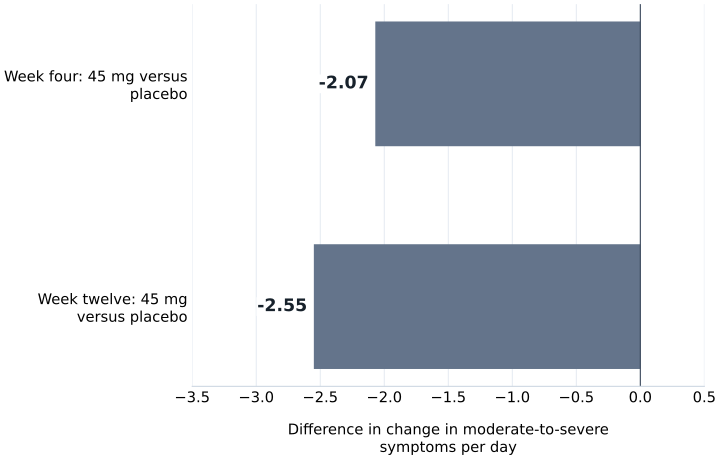
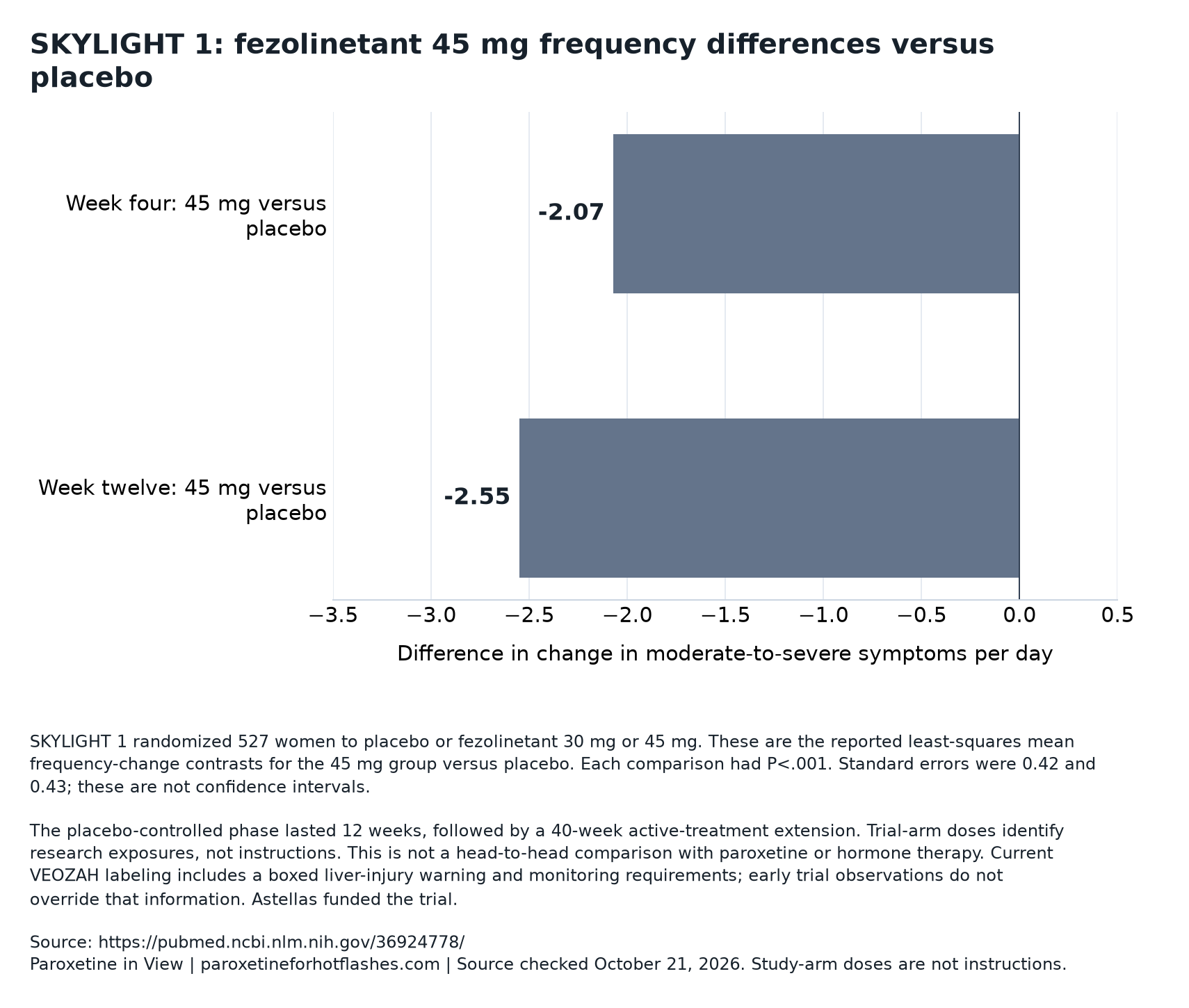
45 mg frequency result: The placebo-adjusted daily frequency differences were −2.07 at week 4 and −2.55 at week 12. Source 1
Current liver precautions: VEOZAH carries a boxed hepatotoxicity warning and requires baseline liver testing, monthly testing for the first three months, and testing at months 6 and 9. Source 2
Separate paroxetine evidence: Two pivotal trials studied the specific oral 7.5 mg paroxetine capsule for 12 or 24 weeks; their pooled sleep analysis was not an independent trial. Source 3 Source 4 Source 5
The question SKYLIGHT 1 was designed to answer
SKYLIGHT 1 was a randomized, double-blind phase 3 trial at 97 facilities in seven countries, including the United States and Canada. Eligible women were 40–65 years old and averaged at least seven moderate-to-severe hot flashes daily. This was a population with frequent symptoms, not a study of occasional warmth or every possible menopause-related complaint.
Participants were assigned equally to matched placebo or once-daily oral fezolinetant study arms of 30 mg or 45 mg. Participants and study personnel were masked to assignment. These doses identify the experimental groups; the current US VEOZAH product is a 45 mg tablet, and the 30 mg arm should not be interpreted as an alternative US-approved regimen.
Fezolinetant blocks neurokinin 3 receptors involved in temperature-regulation signaling. It is not hormone replacement. That pharmacology helps explain the treatment rationale, but symptom outcomes—not the mechanism alone—establish clinical benefit. Astellas Pharma funded the trial; the indexed abstract is the basis for the trial-specific analysis here.
Read the underlying chart data: download CSV or download the source-labeled chart.
Why the participant counts change across analyses
The report describes 2,205 women recruited, but only 527 randomized: 175 to placebo and 176 to each fezolinetant arm. Treating 2,205 as the randomized population would greatly exaggerate the size of the efficacy experiment. The safety population included women who received at least one dose: 175 placebo, 174 in the 30 mg group, and 173 in the 45 mg group.
A medication-assignment error also matters. One participant assigned to 45 mg received 30 mg; the reported efficacy sets therefore contained 173 in the 30 mg group and 174 in the 45 mg group. These small numerical shifts reflect analysis definitions, not additional recruitment or a different study.
Before week 12, treatment was discontinued by 23 placebo participants, 31 in the 30 mg arm, and 13 in the 45 mg arm, mostly because of adverse events or participant withdrawal. Those totals are not all adverse-event discontinuations. The abstract does not provide enough detail to reconstruct missing-data sensitivity analyses or determine how every withdrawal affected the estimates.
Reading the frequency benefit in daily units
The coprimary endpoints were changes from baseline in symptom frequency and severity at weeks 4 and 12. For frequency, the primary report gives model-adjusted differences in change between treatment and placebo. A negative difference favors fezolinetant because it means a greater reduction in daily symptoms.
For 45 mg, those differences were −2.07 at week 4 and −2.55 at week 12, both with P<0.001. The abstract reports standard errors of 0.42 and 0.43, respectively. A standard error describes uncertainty around an estimated group effect; it is not a confidence interval and does not describe how widely individual responses varied.
The current label supplies rounded confidence intervals for this same trial: −2.1 daily symptoms at week 4, with a 95% confidence interval of −2.9 to −1.3, and −2.6 at week 12, with an interval of −3.4 to −1.7. These intervals support an average benefit beyond placebo while leaving uncertainty about its exact size. They do not predict an individual woman’s response.
SKYLIGHT 1 placebo-adjusted frequency findings; negative values indicate greater reductions with fezolinetant.
| Study arm and visit | Difference in daily symptom change | Uncertainty reported in primary abstract |
|---|---|---|
| 30 mg, week 4 | −1.87 | Standard error 0.42 |
| 45 mg, week 4 | −2.07 | Standard error 0.42 |
| 30 mg, week 12 | −2.39 | Standard error 0.44 |
| 45 mg, week 12 | −2.55 | Standard error 0.43 |
Total improvement is not the same as drug-attributable improvement
The label provides a useful worked example. In the 45 mg group, baseline frequency averaged 10.4 daily symptoms, compared with 10.5 on placebo. At week 4, adjusted mean changes were −5.4 and −3.3, respectively. Subtracting the placebo change from the active-treatment change gives approximately −2.1—the extra improvement associated with treatment assignment.
At week 12, corresponding changes were −6.4 and −3.9. The displayed rounded numbers differ slightly from the more precise model contrast, illustrating why subtraction of rounded table entries need not exactly reproduce the published estimate. Neither the active group’s total reduction nor the placebo-adjusted difference should be described as a percentage risk reduction.
The placebo improvement is scientifically important. It shows that change during treatment cannot automatically be assigned entirely to the medicine. Symptom fluctuation and other influences can contribute, although this abstract does not quantify their separate contributions. Randomization makes the between-group contrast more informative than either group’s before-and-after change alone.
Severity and longer follow-up answer different questions
Severity improved as well as frequency. For 45 mg, placebo-adjusted severity differences were −0.19 at week 4 and −0.20 at week 12; for 30 mg, they were −0.15 and −0.24. These are severity-score units, not numbers of hot flashes. The results should not be added to frequency reductions or translated into a percentage of women whose symptoms disappeared.
The numerical pattern also discourages a simplistic dose-response claim. Although the 45 mg frequency contrasts were somewhat larger, the 30 mg severity contrast was numerically larger at week 12. The abstract reports comparisons against placebo, not evidence that one active dose was statistically superior to the other.
Improvement appeared after one week and was reported as maintained through 52 weeks. However, placebo comparison ended after week 12; the next 40 weeks involved active treatment. Longer follow-up therefore supports persistence of observed improvement, not a year-long placebo-adjusted effect. The report identifies quality of life, mood, and sexual well-being as areas needing further characterization rather than established benefits.
Early adverse-event counts do not settle liver safety
During the first 12 weeks, treatment-emergent adverse events occurred in 37% of the 30 mg safety group, 43% of the 45 mg group, and 45% of placebo recipients. These are events arising during treatment, not necessarily events caused by it. A lower overall event percentage does not establish protection from particular adverse effects.
The primary abstract reported liver-enzyme elevations in two women receiving 30 mg, none receiving 45 mg, and one receiving placebo. Events were generally asymptomatic and transient. Those historical counts describe a small, short comparison; zero observed events in one arm is not evidence of zero underlying risk.
Broader evidence in the current label changes the picture. Across three trials, transaminase elevations above three times the upper limit of normal occurred in 2.3% receiving VEOZAH and 0.9% receiving placebo. This is a 1.4-percentage-point difference in those pooled data, not a current incidence estimate for serious liver injury. Reported exposure-adjusted rates were 2.7 versus 1.5 per 100 person-years, a different measure that accounts for observation time.
What the current boxed liver warning requires
The February 2026 VEOZAH labeling includes a boxed warning for hepatotoxicity, meaning liver injury. Postmarketing cases of serious drug-induced liver injury occurred within 40 days of starting treatment. Voluntary reports cannot reliably establish frequency because the total exposed population and completeness of reporting are uncertain.
The label requires baseline ALT, AST, alkaline phosphatase, and total and direct bilirubin testing. Treatment must not begin when ALT or AST is at least twice the laboratory’s upper limit of normal, or total bilirubin is at least twice that limit. Follow-up testing is monthly for the first three months, then at months 6 and 9. Scheduled monitoring does not replace evaluation when symptoms arise.
The warning instructs patients with possible liver-injury symptoms—including new fatigue, decreased appetite, nausea, vomiting, itching, jaundice, pale stools, dark urine, or abdominal pain—to stop VEOZAH immediately and seek medical attention. Clinician-directed discontinuation thresholds include transaminases above five times normal, or above three times normal together with bilirubin above twice normal.
The exact contraindications are known cirrhosis, severe renal impairment or end-stage renal disease, and concomitant CYP1A2 inhibitors. The interaction restriction includes weak, moderate, and strong inhibitors, not just the strongest examples. As with the full medicine-list guide, the practical issue is a complete medication record, not merely recognition of a familiar brand name.
The paroxetine trials studied a different product and population
The pivotal paroxetine studies randomized 1,184 postmenopausal women: 591 to paroxetine 7.5 mg and 593 to placebo. One study lasted 12 weeks and the other 24 weeks. The current label’s efficacy population totals 1,174 because eligibility for that analysis required usable baseline and on-treatment diary data plus treatment exposure.
All four primary endpoints were met in the 24-week study; three of four were met in the 12-week study. The exception was severity at week 12 in the shorter trial. At week 24 in the longer trial, 48% receiving the capsule versus 36% receiving placebo achieved at least a 50% reduction in symptom frequency—a 12-percentage-point responder difference, not a 48% mean symptom reduction.
These findings concern the specific oral 7.5 mg paroxetine capsule. They do not transfer its menopause indication to higher-dose tablets, psychiatric treatment, or insomnia. The capsule-versus-tablet guide explains that identity issue, while the companion paroxetine symptom and sleep analysis examines the same trial program in greater depth. Neither program directly compared paroxetine with fezolinetant.
Three evidence questions that should remain separate.
| Evidence | Design and duration | What it directly addresses |
|---|---|---|
| SKYLIGHT 1 | 527 randomized; 12-week placebo comparison plus 40-week active extension | Fezolinetant frequency and severity effects versus placebo |
| Paroxetine pivotal efficacy trials | 1,184 randomized across separate 12- and 24-week placebo-controlled trials | Specific 7.5 mg capsule effects on menopausal vasomotor symptoms |
| Paroxetine pooled sleep analysis | Secondary diary outcomes from those same trials; weeks 1–12 pooled | VMS-attributed awakenings and reported sleep duration, not independent replication |
Sleep findings are narrower than an insomnia claim
The paroxetine sleep analysis prospectively examined predefined secondary outcomes from the same two pivotal trials. At week 4, VMS-attributed awakenings decreased 39% with paroxetine and 28% with placebo. The underlying means fell from 3.56 to 2.17 and from 3.64 to 2.63 awakenings nightly: an additional reduction of about 0.38 awakenings, not one fewer awakening every night for every participant.
Reported sleep duration increased 31 minutes versus 16 minutes at week 4, making the between-group gain 15 minutes. Corresponding gains beyond placebo were 12 minutes at week 12 and 10 minutes at week 24. Only the longer trial contributed week-24 data. There was no significant difference in time to fall asleep, and broader difficulty-sleeping ratings did not significantly separate the groups.
The measures were self-reported, not laboratory sleep recordings, and recorded awakenings attributed to VMS rather than all causes. Sleep-related treatment-emergent events occurred in 3.1% of each group during treatment; this is not the incidence of all adverse events. Noven Pharmaceuticals funded both trials and writing support. These findings cannot establish fezolinetant sleep benefits or replace evaluation of other sleep problems.
Comparing care proposals without inventing a drug ranking
Paroxetine has its own important safety profile. BRISDELLE carries a boxed suicidal-thoughts-and-behaviors warning; pooled phase 2 and 3 data included three serious suicidal-ideation reports and one suicide attempt with active treatment versus none with placebo. Common reactions included headache, fatigue-related symptoms, and nausea or vomiting. These data are not directly comparable with SKYLIGHT 1 event percentages.
Additional concerns include serotonin syndrome, bleeding, low sodium, sexual dysfunction, and interactions. Paroxetine strongly inhibits CYP2D6 and can reduce the active tamoxifen metabolite; clinical outcome studies are mixed, and the label advises considering avoidance of concurrent use. The tamoxifen discussion guide addresses that distinct coordination issue. Favorable short-term trial observations do not erase current warnings or discontinuation symptoms.
Editorial interpretation: a treatment comparison should include the exact product, documented benefit, monitoring responsibilities, and follow-up arrangements rather than rank drugs using unrelated trial numbers. The treatment-review questions offer a structure. The Evernow review and CoreAge Rx review can be used to check documentary terms only; these links do not establish availability of fezolinetant, condition-specific care, or outcomes. Neither trial supplies comparative prices, contract terms, or provider performance evidence.
Questions about the evidence
Does −2.55 mean fezolinetant reduced hot flashes by only 2.55 per day?
No. It is the additional reduction versus placebo at week 12 in the 45 mg arm. Both groups improved. The label reports adjusted changes of approximately −6.4 daily symptoms with active treatment and −3.9 with placebo. The between-group contrast is the relevant estimate of added treatment benefit, not the active group’s entire before-and-after improvement.
Did SKYLIGHT 1 establish a full year of benefit over placebo?
It established placebo-controlled effects through 12 weeks and reported maintained improvement over 52 weeks. The subsequent 40 weeks involved active treatment, so the later observations lack a continuing placebo comparison. They inform persistence during treatment but cannot quantify what the year-long difference from continuing placebo would have been.
Why does current liver guidance matter if the 45 mg trial arm had no reported enzyme elevations?
A small trial arm can miss uncommon harm. Larger pooled trial data and postmarketing experience identified liver concerns that the short SKYLIGHT 1 comparison could not fully characterize. Current labeling therefore requires laboratory monitoring and includes a boxed warning. The frequency of serious postmarketing liver injury cannot be reliably calculated from voluntary reports.
Can the trial numbers show whether fezolinetant works better than paroxetine?
Not directly. Participants were not randomized between those two medicines. The programs differed in design, analysis, follow-up, and reporting, including model-adjusted means versus some label-reported medians. Comparing isolated placebo-adjusted numbers across programs can generate hypotheses, but it does not establish comparative superiority or a personalized treatment ranking.
Does the paroxetine sleep analysis support treating every kind of insomnia?
No. It studied secondary, self-reported sleep outcomes among women enrolled for frequent menopausal VMS. Benefits involved VMS-attributed awakenings and reported sleep duration, without significant improvement in time to fall asleep. BRISDELLE is indicated for moderate-to-severe menopausal VMS, not insomnia or psychiatric conditions, and its results do not establish benefits for higher-dose tablets.
What this evidence supports
SKYLIGHT 1 provides convincing short-term placebo-controlled evidence that fezolinetant reduces moderate-to-severe menopausal VMS frequency and severity. Its 52-week observations support persistence but are not a year-long placebo comparison. Current liver warnings materially shape interpretation of the early safety findings. Paroxetine’s specific 7.5 mg capsule has separate efficacy and secondary sleep evidence, with different warnings and interactions. The scientifically defensible conclusion is that both have product-specific evidence—not that unrelated trial numbers establish which is best.
Research access and limitations
The SKYLIGHT 1 and primary paroxetine efficacy analyses rely on indexed primary-report abstracts and available official labeling; the paroxetine sleep full article was accessible. This review does not claim examination of all protocols, supplements, or individual participant data. Current prescribing information supplies safety context beyond the original trial reports.
Source records
Each record supports its own product, purpose and context. A service description does not establish an individual treatment outcome.
- Fezolinetant for treatment of moderate-to-severe vasomotor symptoms associated with menopause (SKYLIGHT 1): a phase 3 randomised controlled study.Indexed primary study abstract · Checked 2026-10-21
- VEOZAH (fezolinetant) US prescribing informationOfficial prescribing label or regulatory statement, full public page · Checked 2026-10-21
- Low-dose paroxetine 7.5 mg for menopausal vasomotor symptoms: two randomized controlled trials.Indexed primary study abstract · Checked 2026-10-21
- Low-dose paroxetine (7.5 mg) improves sleep in women with vasomotor symptoms associated with menopause.Indexed primary study abstract and full research article · Checked 2026-10-21
- DailyMed — BRISDELLE paroxetine capsule, Legacy Pharma USA, Inc.Exact 7.5 mg capsule label, internally revised April 2025 and page updated April 28, 2025. Menopausal vasomotor indication and psychiatric-indication limitation; product-specific warnings and qualified tamoxifen interaction context. Not a provider formulary or individual dose instruction. · Checked 2026-10-21