Paroxetine’s menopause evidence concerns a specific product and a specific clinical problem: an oral 7.5 mg paroxetine mesylate capsule studied in postmenopausal women with frequent moderate to severe hot flashes. Two randomized trials tested treatment over 12 or 24 weeks. They found reductions in hot-flash frequency, while results for symptom severity were not uniformly significant. A later analysis examined sleep measurements collected prospectively in those same trials.
The sleep findings are useful precisely because they are narrower than a general claim of better sleep. Participants reported fewer awakenings they attributed to hot flashes or night sweats and somewhat longer sleep duration. They did not show a statistically significant advantage in falling asleep faster. Understanding the evidence requires separating total improvement from improvement beyond placebo, secondary sleep outcomes from primary symptom outcomes, and trial tolerability from current prescribing warnings.
Sections in this article
Study facts at a glance
Two pivotal trials: Across the 12- and 24-week studies, 591 women were randomized to paroxetine 7.5 mg and 593 to placebo. Source 1 Source 2
Primary endpoints: The 24-week study met all four primary endpoints; the 12-week study met three, with week-12 severity not significantly different from placebo. Source 1 Source 3
Nighttime awakenings: At week 4, awakenings attributed to vasomotor symptoms declined 39% with paroxetine versus 28% with placebo. Source 2
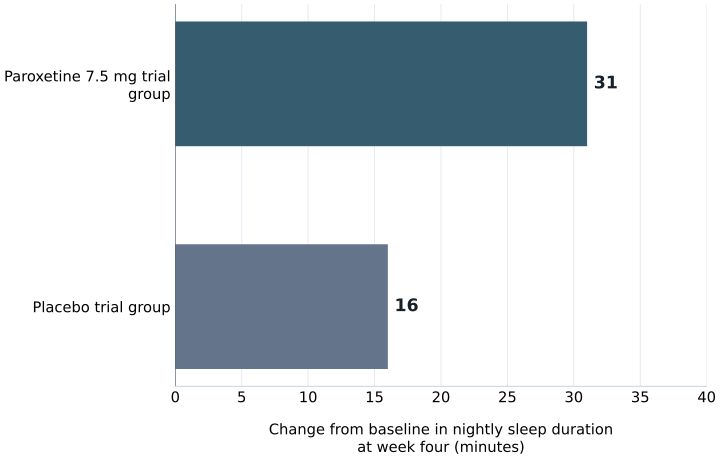
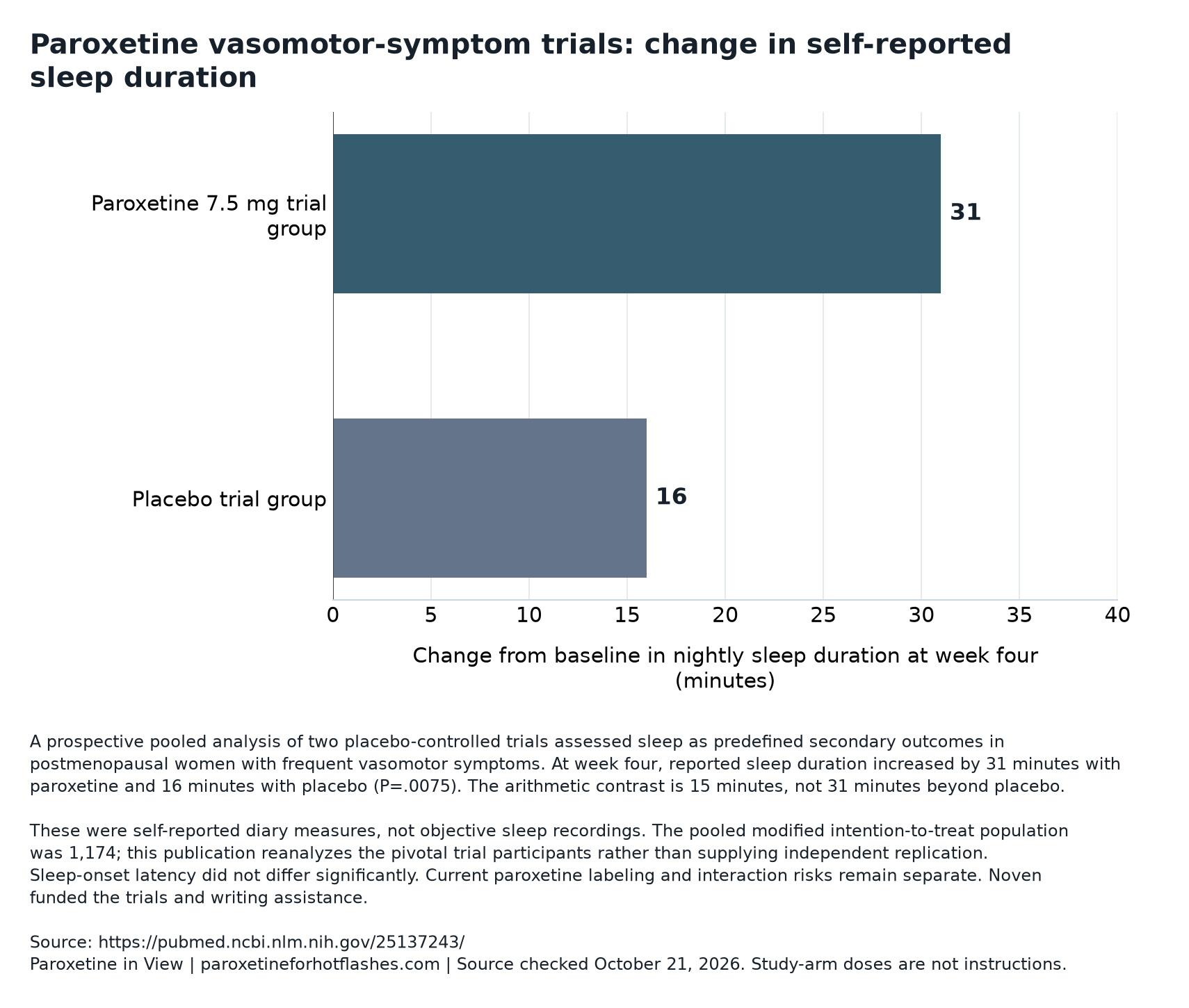
Sleep duration: Week-4 sleep duration increased 31 minutes with paroxetine and 16 minutes with placebo: an arithmetic contrast of 15 minutes. Source 2
Product and safety boundary: Brisdelle’s menopause indication applies to the 7.5 mg capsule, not higher-dose tablets; its current label includes a boxed warning about suicidal thoughts and behaviors. Source 3
The trials tested a capsule, not paroxetine as an interchangeable category
Both phase 3 studies were multicenter, randomized, double-blind, placebo-controlled trials. Participants were assigned in equal proportions to an identical-looking placebo or the oral 7.5 mg capsule once daily at bedtime. The shorter study randomized 614 women; the longer study randomized 570. Random assignment and masking strengthen the comparison by reducing systematic differences in who received treatment and how expectations might influence reporting.
The formulation matters. Brisdelle is indicated for moderate to severe vasomotor symptoms associated with menopause—hot flashes and night sweats—not insomnia or psychiatric conditions. Its lower paroxetine dosage has not been established as effective for psychiatric treatment. The guide to Brisdelle and paroxetine tablets explains why a shared drug name does not make every formulation’s approval interchangeable.
This analysis uses the indexed primary hot-flash report abstract, the accessible full sleep research article, and current official labeling. It does not assume that every protocol or supplement was examined. Neither the capsule’s approval nor these clinical results automatically transfers to higher-dose tablets, compounded preparations, other formulations, or a particular care provider.
Read the underlying chart data: download CSV or download the source-labeled chart.
Participants had frequent symptoms, but were medically selected
Eligibility required postmenopausal status, age at least 40, and approximately seven to eight or more moderate to severe hot flashes daily, or 50 to 60 weekly, for at least 30 days before screening. In the pooled sleep analysis, average baseline frequency was 11.3 vasomotor episodes per day. This was therefore a symptomatic population, not a trial of occasional warmth or sleep difficulty alone.
The studies excluded women with a history of diagnosis or treatment of depression or other psychiatric disorders, known failure of previous SSRI or SNRI treatment for vasomotor symptoms, and important unstable or impaired cardiac, liver, or kidney conditions. No sleep-specific exclusions for sleep apnea or restless legs were applied. Their possible presence does not establish efficacy for either disorder.
A placebo run-in lasting up to 12 days preceded randomization. Most psychotropic drugs were prohibited; several sleep medicines were permitted, but nightly use was minimal and not separately analyzed. More than 80% completed the studies. These design choices help define the result’s applicability, particularly for people with psychiatric histories or complex medication regimens.
Hot-flash frequency improved more consistently than severity
Each trial had four primary efficacy endpoints: changes in vasomotor symptom frequency and severity at weeks 4 and 12. Frequency measures how often symptoms occur; severity measures their intensity. Both studies found significantly greater reductions in frequency with paroxetine at both time points. Only the longer trial met all four endpoints; week-12 severity in the shorter trial was nonsignificant, with a label-reported P value of 0.17.
The label provides daily-frequency medians that make the scale easier to interpret. At week 12 in the shorter trial, median reductions were 5.9 episodes daily with paroxetine and 5.0 with placebo, a difference between median changes of 0.9. In the longer trial, corresponding reductions were 5.6 and 3.9, a difference of 1.7. Those are daily symptom counts, not sleep outcomes or average benefits every individual received.
These results support an effect on frequency without making every severity comparison positive. The label’s reported median contrasts also should not be silently substituted for the primary abstract’s description of mean weekly outcomes. They summarize related evidence using different statistical presentations.
Daily hot-flash frequency in the two trials, using label-reported median changes
| Study and time | Paroxetine versus placebo change | Difference between median changes |
|---|---|---|
| 12-week trial, week 4 | −4.3 versus −3.1 episodes/day | −1.2 episodes/day |
| 12-week trial, week 12 | −5.9 versus −5.0 episodes/day | −0.9 episodes/day |
| 24-week trial, week 4 | −3.8 versus −2.5 episodes/day | −1.3 episodes/day |
| 24-week trial, week 12 | −5.6 versus −3.9 episodes/day | −1.7 episodes/day |
The sleep paper reanalyzed the same trial population
The sleep findings were predefined secondary outcomes, meaning researchers planned to assess them but did not make them the trials’ primary efficacy tests. Data through week 12 were pooled across both trials. Weeks 13 through 24 came only from the longer study. The sleep paper is therefore an additional analysis of the pivotal experiments, not an independent replication in newly recruited participants.
Of 1,184 randomized women, 1,174 entered the modified intent-to-treat analysis: 585 receiving paroxetine and 589 placebo. This set required valid baseline diaries, at least one dose, and at least one on-treatment diary day. The sleep safety population included 1,175 women. The differing counts reflect analysis definitions rather than separate trials or contradictory enrollment totals.
Participants used electronic diaries to report awakenings they attributed to vasomotor symptoms, sleep duration, and sleep-onset latency—the time needed to fall asleep. These were self-reports, not sleep-laboratory recordings. Pooling increased the amount of information for the early comparisons, but it did not turn secondary sleep measurements into primary insomnia endpoints.
Fewer awakenings: a moderate additional benefit beyond placebo
Participants initially reported about 3.6 awakenings each night attributed to vasomotor symptoms. At week 4, the paroxetine group declined from 3.56 to 2.17 awakenings, while placebo declined from 3.64 to 2.63. The reported reductions were 39% and 28%, respectively, with a between-group P value of 0.0049. The 11-percentage-point gap describes the difference between those baseline-relative reductions, not an 11% reduction in everyone’s risk.
A worked comparison is more informative than the active arm alone. The respective absolute declines were 1.39 and 1.01 awakenings nightly. Subtracting those changes gives 0.38 additional awakenings reduced per night with paroxetine. The final group means differed by 0.46 because the starting means were slightly different. Neither figure promises a particular pattern of uninterrupted nights for an individual.
At week 12, reported reductions were 54% versus 43%, with final means of 1.65 versus 2.08. At week 24 in the longer trial alone, reductions were 62% versus 43%, ending at 1.36 versus 2.02. Importantly, the diaries did not establish whether awakenings unrelated to hot flashes changed or how long each awakening lasted.
Longer sleep did not mean 31 extra minutes beyond placebo
At week 4, reported nighttime sleep increased by 31 minutes with paroxetine and 16 minutes with placebo. The arithmetic difference was 15 minutes—not 31 minutes attributable to treatment beyond the comparator. The between-group comparison was statistically significant, with P = 0.0075. Both groups’ improvement belongs in any practical interpretation of the result.
Sleep-duration gains continued at later assessments, but the additional gain beyond placebo was numerically smaller: 12 minutes at week 12 and 10 minutes at week 24. These are simple contrasts of reported group changes, not newly calculated model estimates. The accessible numerical reporting does not provide confidence intervals for these paroxetine sleep contrasts, so their precision should not be invented.
Interpretation: a modest average extension of sleep may matter to someone whose nights are repeatedly interrupted, but minutes alone do not establish restoration of daytime functioning or resolution of insomnia. The treatment-review questions guide separates measurable symptom changes from broader goals that these trials did not conclusively demonstrate.
Reported changes in nighttime sleep duration and their arithmetic contrasts
| Assessment and data source | Paroxetine versus placebo gain | Arithmetic difference |
|---|---|---|
| Week 4, pooled trials | +31 versus +16 minutes | +15 minutes |
| Week 12, pooled trials | +35 versus +23 minutes | +12 minutes |
| Week 24, longer trial only | +37 versus +27 minutes | +10 minutes |
Other sleep measures make the conclusion more specific
There was no statistically significant between-group difference in sleep-onset latency. At week 4, time to fall asleep shortened by seven minutes with paroxetine and eight with placebo. That finding differs from the advantage observed for sleep duration and symptom-attributed awakenings. It supports a selective pattern of improvement rather than a demonstrated general sleep-inducing effect.
A hot-flash-related sleep-interference rating improved significantly more with paroxetine at week 4, but not at weeks 12 or 24. A separate questionnaire item on difficulty sleeping showed no significant treatment-group difference at any assessed time. The sleep article also notes that the isolated sleep-interference item had not itself been validated for this use.
The authors proposed that fewer vasomotor symptoms, rather than sedation, could explain the sleep pattern. That remains an interpretation, not a proven causal pathway. No significant sedation difference does not establish that no individual experiences sedation. Objective sleep recordings, validated insomnia scales, and measurements of daytime function would help determine how these diary changes translate into broader sleep health.
Persistence through 24 weeks is not evidence of indefinite benefit
The longer trial supplied evidence that benefit persisted through 24 weeks of treatment. Its symptom responder analysis defined success as at least a 50% reduction in moderate to severe hot-flash frequency. At week 24, 48% of the paroxetine group and 36% of placebo met that threshold, a 12-percentage-point difference.
Those responder percentages are not mean symptom reductions: 48% means the share reaching a specified threshold, not that the average participant’s symptoms fell 48%. The longer follow-up also does not establish benefit after treatment ends or beyond the observed period. The sleep results at week 24 similarly describe continued treatment in one trial, not two-trial confirmation at that time point.
Noven Pharmaceuticals funded both studies and the sleep article’s medical-writing and editorial assistance. Two authors were Noven employees; other authors disclosed consulting, research, or travel relationships. Sponsorship does not erase randomization, but it makes transparent outcome selection, complete reporting, and independent confirmation especially important.
Current safety labeling adds information the sleep results cannot supply
During treatment, 3.1% in each sleep-analysis arm reported a sleep-related adverse event. After discontinuation, the proportions were 1.4% with paroxetine and 0.3% with placebo. These are sleep-event figures, not the incidence of all adverse effects. The original trial abstract described most treatment-emergent events as mild or moderate.
The current label pools phase 2 and phase 3 safety data: 635 active-treatment and 641 placebo recipients. Headache occurred in 6.3% versus 4.8%, fatigue-related reactions in 4.9% versus 2.8%, and nausea or vomiting in 4.3% versus 2.3%. Adverse reactions led to discontinuation in 4.7% versus 3.7%. Three serious suicidal-ideation reactions and one suicide-attempt reaction were reported with Brisdelle, versus none with placebo.
The boxed warning addresses suicidal thoughts and behaviors, and other warnings include serotonin syndrome, bleeding, low sodium, mood activation, seizures, and sexual dysfunction. Contraindications include certain MAOI exposures, thioridazine, pimozide, hypersensitivity, and pregnancy. Strong CYP2D6 inhibition can reduce the active tamoxifen metabolite; clinical outcome studies are mixed. The tamoxifen discussion guide and full medicine-list guide organize those review questions. Current labeling also reports discontinuation symptoms, so trial cessation observations are not personal stopping or tapering instructions.
Other nonhormonal evidence does not create a head-to-head ranking
Historical descriptions of paroxetine as the only approved nonhormonal menopause treatment are obsolete. Fezolinetant is another approved option. In the Astellas-funded SKYLIGHT 1 trial, 527 women were randomized to placebo or fezolinetant 30 or 45 mg. The 45 mg arm’s week-12 frequency advantage was 2.55 fewer episodes daily by the abstract’s adjusted mean estimate. Current labeling gives the rounded contrast as −2.6, with a 95% confidence interval of −3.4 to −1.7.
That is not a comparison against paroxetine. Different populations and statistical summaries prevent a reliable ranking from these numbers. SKYLIGHT 1 had 12 placebo-controlled weeks followed by a 40-week active-treatment extension, not 52 weeks of placebo control. Its early liver findings also do not replace the current hepatotoxicity boxed warning and laboratory monitoring requirements, discussed in the SKYLIGHT 1 analysis.
Editorial interpretation: product identity and documentary care terms should remain separate from trial efficacy. The CoreAge Rx review and Evernow review offer places to check those terms, not evidence that either service supplies the studied capsule or reproduces its outcomes. These trials measured no provider-specific benefit, contract value, or cost effectiveness.
Questions about the evidence
Was the sleep analysis a separate randomized trial?
No. It examined predefined secondary sleep measurements from the same two randomized hot-flash trials. Combining their early data increased the sample available for analysis, but did not provide independent replication. Only the longer trial contributed week-24 data.
Does the sleep finding make Brisdelle an insomnia treatment?
No. Its indication is moderate to severe menopause-associated vasomotor symptoms. The studies enrolled women for frequent hot flashes, not an insomnia diagnosis. Symptom-attributed awakenings and sleep duration improved, but falling-asleep time and the general difficulty-sleeping questionnaire item did not show significant treatment advantages.
How much longer did participants sleep because of treatment?
At week 4, sleep increased 31 minutes with paroxetine and 16 minutes with placebo. Their simple difference is 15 minutes. That is the useful comparator-based arithmetic, although it is not a newly estimated statistical effect with a confidence interval. Individual experiences could differ substantially from either group average.
Do these results establish the same effects for higher-dose tablets?
No. The pivotal intervention was the oral 7.5 mg paroxetine mesylate capsule. Higher-dose products have separate labeling and evidence. These trials cannot establish their exact hot-flash benefit, sleep effect, or adverse-event frequency, and the capsule’s menopause approval cannot simply be borrowed for them.
Why discuss serious warnings when most trial events were mild or moderate?
Severity descriptions summarize common trial experience; they do not exclude uncommon serious harm. Current labeling incorporates broader clinical and postapproval information. Psychiatric-history exclusions also limit what these trials reveal about some patients. The boxed warning, interaction review, and reported discontinuation symptoms remain relevant despite the modest average sleep benefit.
What this evidence supports
The strongest conclusion is product-specific: paroxetine 7.5 mg capsules reduced frequent menopause-related hot flashes and produced modest additional improvements in symptom-attributed awakenings and reported sleep duration versus placebo. Frequency results were more consistent than severity results, and broader sleep questionnaires did not uniformly favor treatment. The sleep analysis adds useful detail but not an independent trial population. Current labeling supplies essential safety information that favorable averages cannot negate. Interpretation should therefore connect the exact formulation and symptom goal to the measured outcomes, without promising insomnia relief, provider-specific results, or freedom from adverse effects.
Research access and limitations
The hot-flash primary report and SKYLIGHT 1 were assessed through indexed abstracts alongside official labeling; the full paroxetine sleep article was available. Sleep measurements were self-reported secondary outcomes, and the accessible reporting did not supply confidence intervals for the paroxetine sleep contrasts. Follow-up beyond 12 weeks came from only one paroxetine trial.
Source records
Each record supports its own product, purpose and context. A service description does not establish an individual treatment outcome.
- Low-dose paroxetine 7.5 mg for menopausal vasomotor symptoms: two randomized controlled trials.Indexed primary study abstract · Checked 2026-10-21
- Low-dose paroxetine (7.5 mg) improves sleep in women with vasomotor symptoms associated with menopause.Indexed primary study abstract and full research article · Checked 2026-10-21
- DailyMed — BRISDELLE paroxetine capsule, Legacy Pharma USA, Inc.Exact 7.5 mg capsule label, internally revised April 2025 and page updated April 28, 2025. Menopausal vasomotor indication and psychiatric-indication limitation; product-specific warnings and qualified tamoxifen interaction context. Not a provider formulary or individual dose instruction. · Checked 2026-10-21
- Fezolinetant for treatment of moderate-to-severe vasomotor symptoms associated with menopause (SKYLIGHT 1): a phase 3 randomised controlled study.Indexed primary study abstract · Checked 2026-10-21
- VEOZAH (fezolinetant) US prescribing informationOfficial prescribing label or regulatory statement, full public page · Checked 2026-10-21